How to request a plastic injection moulding quote and which details drive the price
A quote is only as accurate as the information that comes with it. We explain what to send, how each detail affects the price of your part and what to do if you do not have it yet.
Guides15 min read
In brief
- The cost of each injection-moulded part is made up of, among other items, its share of the mould, the material, machine time and any secondary operations, and the information you send makes those items more accurate.
- Send the 3D model as a STEP file together with a PDF drawing showing the critical dimensions and their tolerances, because many STEP files carry the shape but not the tolerances.
- The total quantity determines how much of the mould cost each part carries, and a forecast by week, month and year helps decide how many cavities pay off.
- The international standard on tolerances for moulded parts is ISO 20457:2026, which does not mention blow moulding, so for a blow-moulded part it is best to agree the tolerances on the drawing.
- If the part will come into contact with food, state which foods, at what temperature and for how long, because the declaration of compliance sets out those conditions.
To assess a plastic part, we need to know what has to be made, in what material and in what quantity. If any of these is missing, it has to be assumed, and an assumption may not match what you need.
Here we explain what information to gather for an injection-moulded or blow-moulded part and how each item affects the price. We manufacture by injection moulding and blow moulding at our factory in Tibi (Alicante). Our injection moulding machines range from 100 to 500 t of clamping force. You will find a checklist at the end.
What determines the price of a plastic part?
Link to the section What determines the price of a plastic part?A university plastics textbook works out the cost of an injection-moulded part item by itemSource 1. These are the main items that depend on your part, and they explain why we ask for each piece of information.
- Material, based on the part weight, the scrap (the material lost along the way) and the price of the plastic and its additivesSource 1.
- Mould, whose cost can be spread across the parts. If the customer supplies their own mould, that share is not included in the priceSource 1.
- Machine, the hourly rate of the injection moulding machine divided by the number of parts it produces in an hourSource 1.
- Secondary operations, such as assembly, drilling or machining, with their time and their rateSource 1.
- Packaging, which is a product cost, and transport only if the price includes itSource 1.
Every missing detail is an assumption
With a complete enquiry, the price relies on fewer assumptions and is easier to compare.
Why wall thickness has such an impact on the cycle
Link to the section Why wall thickness has such an impact on the cycleThe cycle is the time the injection moulding machine takes to produce one shot of parts. A large part of that time goes into cooling them until they can withstand ejectionSource 2. In the cooling equation, thickness is squared, which is why it is the most influential factorSource 2. With the same material and the same temperatures, a wall twice as thick takes around four times as long to cool. If a thick section serves no function, it is worth reviewing it before the mould is made.
Which part files should you send?
Link to the section Which part files should you send?Start with the 3D model in a neutral format, one that can be opened in software other than the program that created it. One of the most widespread is STEP (ISO 10303-21)Source 3, designed for exchanging product data between computer systemsSource 4. IGES is another neutral option for exchanging the definition of a part between design and manufacturing softwareSource 5.
The 3D model alone may not be enough. For years, the shape was sent in STEP AP203, one of the most widely used application protocols alongside AP214Source 4, and the dimensions and tolerances were copied by hand from the drawingSource 3. AP242, published in 2014 to replace the earlier protocols, can carry them within the fileSource 3, provided the recipient can read them. That is why it is worth adding a 2D drawing in PDF, which will also be the reference for approving the samplesSource 6. It should include the following.
- The critical dimensions, each with its tolerance, for example the diameter where a shaft fits or the distance between two fixing points.
- The material and its grade, or the requirements it must meet.
- The finish of each visible surface and the areas where no mark is allowed.
- The drawing number and its revision, so that everyone is working from the same versionSource 1.
Why does the material change the price so much?
Link to the section Why does the material change the price so much?The plastic and its specific grade should be clearly stated from the very first enquirySource 1. The same plastic is sold in different grades, with higher or lower flow or with glass fibre, which are processed differentlySource 7Source 8.
The material affects the price through its cost per kilo and through its processing. Some plastics absorb moisture and must be dried before mouldingSource 7. Each plastic shrinks by its own amount as it cools, known as shrinkage, and the mould cavity is enlarged according to the material’s nominal shrinkageSource 9. That is why a mould designed for one plastic may not give the same dimensions with another.
| Material | Drying before moulding | Shrinkage | Mould temperature |
|---|---|---|---|
| Polypropylene (PP) | Not usually needed if stored properlySource 10 | 1.8 to 2.5%, and 0.7% with 30% glass fibreSource 10 | 20 to 80 °CSource 10 |
| Polycarbonate (PC) | 3 to 4 hours at 100 to 120 °C, until moisture falls below 0.02%Source 7 | Low and consistentSource 7 | 70 to 120 °CSource 7 |
| Polyamide 66 (PA66) | Only if the packaging has been opened, in a drying oven at 85 °CSource 8 | 1 to 2%, and 0.2 to 1% with glass fibreSource 8 | 80 °C recommendedSource 8 |
A colder mould shortens the cycle, within the limits of each materialSource 11. If you have not yet chosen the plastic, tell us what the part is for, what temperature it will operate at, whether it will be exposed to sunlight or come into contact with food, and what loads it must withstand.
What quantities should you state, and why do they change the price per part?
Link to the section What quantities should you state, and why do they change the price per part?The relatively high cost of the mould is one of the major drawbacks of injection mouldingSource 1. To spread that cost over the price, the number of parts the mould will produce has to be estimated, and each part carries the mould cost divided by that total quantitySource 1.
So the cost per part can be summed up as two components: a variable cost, which includes the material and machine time, and the mould cost divided by the total quantitySource 1. In the figure, each column is that sum for a given total quantity, which doubles from one column to the next, and you can step through them with its control.
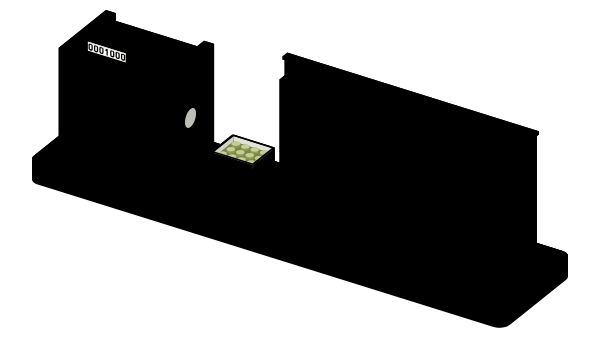
Workshop bench with a closed injection mould topped by a cycle counter, a pallet with a box full of parts beside it and, on the right, eleven columns in front of a ruled board, one for each doubling of the total quantity, from 1,000 to 1,024,000 parts. Each column is the cost per part: a light block, the same in every column, which is the variable cost, topped by a steel sheet, which is the mould share and measures half as much in each column as in the one before. The row drops quickly and then levels off at the height of the variable cost. A carriage on the edge of the bench points to the column for the chosen total quantity, tinted green, at first the one for 1,000 parts, where the mould share is eight times the variable cost. As you step through the quantities, the counter turns and the stack gains a box each time the total quantity doubles. It is the same single-cavity mould for every quantity and the units are relative: the variable cost of one part is 1, and the mould costs as much as the variable cost of 8,000 parts.
The cost per part falls as the total quantity risesSource 12. The columns drop quickly and then level off, because the mould share becomes small compared with the variable cost.
And if fewer parts are made in the end
Someone has to bear the risk that the expected parts are never made, and it is rarely the moulder. That is why, when the mould is spread over the price, the contract usually includes a clause that guarantees those parts within an agreed periodSource 1.
Annual forecast and batch size
Link to the section Annual forecast and batch sizeIt helps to give the forecast by week, month and year, with the demand peaks, and to say how much stock you can storeSource 12. The batch size, the number of parts in each run, also counts. Each run carries a mould changeover cost and a trial material cost, which an injection moulding cost estimation system divides by the parts in the batchSource 13, so it weighs more heavily on a small batch.
How many cavities pay off
Link to the section How many cavities pay offA cavity is each recess in the mould that produces one part per cycle. In the textbook example, the lowest cost per part is achieved with 2 cavities for a total of 200,000 parts, with 4 for 400,000 and with 8 for 800,000Source 12. It is an example, not a rule.
Generally, more cavities mean more variation between parts, and the required precision limits their numberSource 12. Another limit applies when the mark left by the gate, where the plastic enters, must not be visibleSource 12. According to the textbook, with a cold runner a second cavity costs around 60% more than a single one, and with a hot runner, 100% moreSource 12. We explain these systems in our article on types of injection moulds.
How do you specify the colour of a part?
Link to the section How do you specify the colour of a part?Colour is affected by the plastic, the additives, the texture, the shape, the lighting, the environment in which it is used, the process and, above all, the person looking at itSource 14. A colour chart code is a good starting point, but it may not be enough.
It is best to send a physical sample in plastic. A paper, paint or fabric sample can lead to a mismatch due to metamerism when it is matched with a masterbatch, the pigment concentrate that is mixed into the plasticSource 15. Metamerism occurs when two colours that match under one light no longer match under another. It happens because the two samples reflect each region of the spectrum differently, and since each light source distributes its energy differently, the difference shows under some lights and not under othersSource 15.
Add the end use and the applicable regulations, which may restrict the choice of pigmentsSource 15Source 14, along with the material, the thickness, the texture, the light under which the colour will be assessed and the colour difference you can accept. These are, among others, the details a colour concentrate manufacturer asks for to match a shadeSource 14.
The concentrate counts towards the material cost according to its dosing rate, 1% in the textbook exampleSource 1. We explain how a colour difference is measured and toleranced in our article on colour measurement in plastics.
What tolerances should you ask for, and under which standard?
Link to the section What tolerances should you ask for, and under which standard?A tolerance is how far an actual dimension may deviate from the one shown on the drawing. The international standard on tolerances for moulded plastic parts is ISO 20457:2026, the second edition, published in August 2026, which replaces the 2018 editionSource 16. It exists because plastic varies more than metal due to shrinkage, warpage and uneven cooling, and in general the criteria used for metal cannot be applied as they standSource 16.
It lists injection moulding, injection-compression moulding, transfer moulding, compression moulding and rotational moulding, and applies to other processes only if the contracting parties agreeSource 17. Blow moulding is not on that list. In Germany, DIN 16742:2013 gave way to DIN ISO 20457, the German version of ISO 20457:2018, with the same classification principleSource 18. If your drawing still cites DIN 16742, it is worth reviewing the move to ISO 20457:2026 with your supplier, because the standard on the drawing sets the tolerances and the acceptance conditionsSource 16.
Tight tolerances only where they are needed
Tolerances tighter than necessary can increase rejects, lengthen cycles and make the part more expensive, while tolerances that are too wide can compromise fit or assemblySource 16. Only specify an individual tolerance for the dimensions that need one.
Finish, texture and draft angle
Link to the section Finish, texture and draft angleThe part reproduces the surface of the cavity, more or less faithfully depending on the mould temperatureSource 2, so the finish is decided mainly in the mould. For surfaces produced by spark erosion (EDM), a machining process that uses electrical discharges, the VDI 3400 guideline groups roughness into grades from VDI 00 to VDI 45, a scale used worldwide for mouldsSource 19.
A texture calls for a larger draft angle, the taper of the walls that allows the part to be released from the mould. As a guide, 1 to 2 degrees is allowed, plus at least 1.5 degrees for every 0.025 mm of texture depth, so a 0.125 mm leather texture adds at least 7.5 degrees to the normal draftSource 20. The guidelines for each texture are provided by its suppliers or by mould makersSource 20.
What happens between the finished mould and the first production run?
Link to the section What happens between the finished mould and the first production run?Before series production, the mould goes through several trials. They are usually named with a T and a number, and the last one is known as TfSource 6. These are generally names used in practice rather than defined by a standard, so it is worth agreeing what each one includes.
- First trial, to check that the mould works. If it goes well and samples are already being produced, it counts as the first sampling trialSource 6.
- First samples, which may not yet have the final dimensions or surfaceSource 6.
- Dimensional report covering all dimensions, known as first article inspectionSource 6.
- Corrections to the mould wherever the part does not match the 2D or 3D dataSource 6.
- Texturing or polishing, once the dimensions are confirmed. Together with their moulding trial, they can take up to a weekSource 6.
- Final trial under conditions that simulate series production, which ends when its samples are approvedSource 6.
This phase can cause serious delays to a projectSource 6. That is why it is worth stating the date by which you need the first parts and series production, and whether there is a fixed date behind it, such as a product launch.
Already have a mould? What you need to know about it
Link to the section Already have a mould? What you need to know about itWhen the mould already exists, the first step is to check that it fits the injection moulding machine that will run it.
- Clamping force. The force required increases with the injection pressure and with the projected area of all the cavities together, the area they cover when projected onto a single plane, which for each part corresponds to its widest outlineSource 21. The injection moulding machines at our factory range from 100 to 500 t, and we explain that figure in the quality section.
- Size. The mould must fit between the machine’s tie bars, and the machine must open far enough to mount the mould, open it and eject the partSource 21.
- Shot size. The injection capacity must be in proportion to the part, because plastic that stays too long in the barrel can degradeSource 11.
When a mould moves from one moulder to another, it is worth inspecting it with its owner on receipt and gathering its dimensions, its weight, its water and hydraulic connections, and the times, temperatures and materials it used to run withSource 22.
Will it come into contact with food or be used outdoors?
Link to the section Will it come into contact with food or be used outdoors?If the part will come into contact with food, Regulation (EU) No 10/2011 applies in the European UnionSource 23. It establishes a Union list of authorised substances and sets, as a general rule, an overall migration limit, the amount the plastic may release in testing, of 10 mg per dm² of contact surfaceSource 23.
At marketing stages other than retail, there must be a written declaration of compliance. Among other details, it states which foods the part may be used with, the time and temperature of contact and the highest surface-to-volume ratio for which compliance has been verifiedSource 23. So, for a food-contact part, it is worth stating which foods it will be in contact with, at what temperature and for how long.
If it will be used outdoors, tell us that too. Degradation by ultraviolet radiation from the sun is perhaps the most important form of environmental degradation in plastics. Its effect varies greatly from one plastic to another, and it is countered with additives that absorb that radiation, the most common of which is carbon blackSource 24.
And if the part is blow moulded?
Link to the section And if the part is blow moulded?Blow-moulded parts are hollow by natureSource 25, like bottles, and we explain how they are made in the technology section. Almost all of the information above applies to them, with a few differences.
Blow moulding is not a particularly precise process, although injection blow moulding, which starts from an injection-moulded part, allows considerably tighter tolerances than extrusion blow mouldingSource 25. Wall thickness varies because of the process itselfSource 25, so state the minimum you need and where. Since ISO 20457 does not list blow moulding, its tolerances apply only if agreedSource 17, so it is best to set them on the drawing. And if the thread is formed during blowing, it should have a coarse pitch and allow for considerable variationSource 25.
What should your quote request include?
Link to the section What should your quote request include?This table summarises the main information. You do not need all of it to request a quote.
| Item | What to send | Why it changes the price | If you do not have it yet |
|---|---|---|---|
| Geometry | 3D model in STEP and 2D drawing in PDF | Defines the mould and the reference for approving the samplesSource 6 | A sketch with the main dimensions |
| Material | Plastic and grade, or service requirements | Changes the price per kilo, the drying and the shrinkageSource 7Source 9 | The use, temperature and loads |
| Quantities | Total quantity, forecast with peaks, and batch size | Spreads the mould cost and helps choose the number of cavitiesSource 12 | An order of magnitude |
| Colour | Plastic sample and assessment light | The sample is used to match the concentrate, which counts towards the cost according to its dosing rateSource 14Source 1 | A colour chart code |
| Tolerances | Critical dimensions and reference standard | Very tight tolerances can make the part more expensiveSource 16 | Which dimensions must fit with other parts |
| Finish | Texture or polish of each visible surface | Changes the draft and lengthens the trial phaseSource 20Source 6 | A sample of the finish |
| Lead time | Dates for the first parts and for series production | Sets the sequence of trials and correctionsSource 6 | Whether there is a fixed date |
| Mould | New or existing, owner, dimensions, weight and connections | If the customer supplies it, it is generally not included in the priceSource 1 | Photos and any data you still have |
| Use | Food contact, outdoor use, loads and regulations | Determines the material and the documentationSource 23 | Where and how it will be used |
| Delivery | Packaging and destination | Packaging is a product costSource 1 | At least the destination |
Frequently asked questions about quotes
Link to the section Frequently asked questions about quotesHow much does an injection mould cost?
Link to the section How much does an injection mould cost?There is no single figure. One estimation method adds up the machining hours for each part of the mould and multiplies them by a rateSource 12. The price rises with the number of cavities and with a hot runnerSource 12, and ranges from prototype moulds, the most economical, to very high-production moulds, the most expensiveSource 26.
Who owns the mould?
Link to the section Who owns the mould?Normally it belongs to the customerSource 1. Even so, it is worth putting this in writing in the order, especially if its cost is spread over the price.
Shall we review your part together?
Link to the section Shall we review your part together?If you have a part in mind, we will review it with you using whatever information you already have. A member of our team will look after you, with a 100% human service, from the first call through to delivery. We manufacture in Tibi with semi-automated processes and less than 1% of parts returned. Call or write to us and tell us what you need. You will find more short answers in the frequently asked questions on our home page.
Sources
Link to the section SourcesIf you would like to learn more about plastic injection and blow moulding, these sources will help you understand the field better. They are the ones we used to write this article.
- Case Study 12.1 Estimating the Cost of an Injection-Molded Pocket KnifePlastics. Materials and Processing (B. Strong), BYU-Idaho, n.d.Back to the first citation of source 1
- Injection Molding Cooling Time: A BreakdownTechnical publication by an injection moulding training company, 2017Back to the first citation of source 2
- Validation for Downstream Computer Aided Manufacturing and Coordinate Metrology Processes (NIST GCR 16-003)National Institute of Standards and Technology (NIST), 2015Back to the first citation of source 3
- STEP-file, ISO 10303-21Library of Congress, 2026Back to the first citation of source 4
- Initial Graphics Exchange Specification (IGES)The National Archives (UK), PRONOM, n.d.Back to the first citation of source 5
- Introduction to Injection Mold VerificationOutsourced Pharma, 2021Back to the first citation of source 6
- PC materialsTechnical help for injection moulding simulation software, 2015Back to the first citation of source 7
- PA66 materialsTechnical help for injection moulding simulation software, 2015Back to the first citation of source 8
- Mold shrinkage allowanceTechnical help for injection moulding simulation software, 2026Back to the first citation of source 9
- PP materialsTechnical help for injection moulding simulation software, 2015Back to the first citation of source 10
- Critical Operational Parameter and TechniquesPlastics. Materials and Processing (B. Strong), BYU-Idaho, n.d.Back to the first citation of source 11
- Case Study 12.2 Mold Costs and SelectionPlastics. Materials and Processing (B. Strong), BYU-Idaho, n.d.Back to the first citation of source 12
- US7359886B2, Injection-molding cost estimation systemUnited States Patent and Trademark Office, 2008Back to the first citation of source 13
- Specifying Custom Color for PlasticsManufacturer of compounds and colour concentrates for plastics, n.d.Back to the first citation of source 14
- Metamerism ExplainedManufacturer of colour concentrates for plastics, n.d.Back to the first citation of source 15
- ISO 20457:2026 Plastics moulded parts — Tolerances and acceptance conditionsISO, International Organization for Standardization, 2026Back to the first citation of source 16
- ISO 20457:2026EVS, Estonia’s national standards body, 2026Back to the first citation of source 17
- Toleranzmanagment mit DIN ISO 20457FORM+Werkzeug, Carl Hanser Verlag, 2020Back to the first citation of source 18
- 2D and 3D surface roughness parameters of surfaces machined by EDMUniversity of Miskolc, Multidiszciplináris Tudományok, 2024Back to the first citation of source 19
- Draft & TextureeFunda, n.d.Back to the first citation of source 20
- EquipmentPlastics. Materials and Processing (B. Strong), BYU-Idaho, n.d.Back to the first citation of source 21
- Tooling Transfer: Sampling SuccessMoldMaking Technology, 2009Back to the first citation of source 22
- Commission Regulation (EU) No 10/2011 on plastic materials and articles intended to come into contact with food, consolidated textEuropean Union, EUR-Lex, 2026Back to the first citation of source 23
- Environmental Resistance and WeatheringPlastics. Materials and Processing (B. Strong), BYU-Idaho, n.d.Back to the first citation of source 24
- Design for Blow MoldingPlastics. Materials and Processing (B. Strong), BYU-Idaho, n.d.Back to the first citation of source 25
- SPI Class SummaryTechnical summary from a plastic injection moulding company, 2014Back to the first citation of source 26